SHRI SHIVAJI SCIENCE COLLEGE, AMRAVATI
DBT STAR COLLEGE PROJECT ACTIVITY
ACTIVITY REPORT

LABORATORY SAFETY PROCEDURES, FIREFIGHTING, DISASTER AND EQUIPMENT MANAGEMENT
Activity Dates: Monday, 1 July 2024
Type of Activity: Other
Organizing Department: Department of Environmental Science
Program Coordinators: Mr. V. D. Bute
Head of the Department: Dr. S. P. Ingole
External Collaborator (if any): Non-Teaching Staff Development and Welfare Committee (NTSDC) of Shri Shivaji Science College, Amravati
Objectives:
- 1. To provide basic knowledge about the use of appropriate laboratory safety procedures,
- 2. Proper management of Laboratory equipment’s
- 3. To know about Firefighting and Disaster Management.
- 5. To enhance awareness about laboratory equipment handling and maintenance.
- 6. To build a culture of safety and preparedness within the institution.
No of Beneficieries: 50
Classes Involved: Non Teaching Staff of College
Venue of the Activity: C. V. Raman Auditorium
Activity Report:
On Monday, 1st July 2024, the Department of Environmental Science in collaboration with the Non-Teaching Staff Development and Welfare Committee (NTSDC) of Shri Shivaji Science College, Amravati, organized a one-day workshop on “Laboratory Safety Procedures, Firefighting, Disaster and Equipment Management.” The event commenced at 11:30 AM in the college seminar hall and was exclusively conducted for the non-teaching staff of various departments. This program was an important initiative aimed at strengthening institutional safety infrastructure by enhancing the preparedness and skillset of non-teaching faculty, who are the backbone of laboratory operations, equipment handling, and emergency response in any academic setup.
The inaugural ceremony was marked by the gracious presence of respected dignitaries. Hon’ble Dr. G. V. Korpe, Principal of Shri Shivaji Science College, Amravati, presided over the function. In his welcome address, Dr. Korpe emphasized the importance of developing a safety-conscious institutional culture and underlined the role of trained support staff in minimizing laboratory-related risks and accidents. He appreciated the joint efforts of the Department of Environmental Science and the NTSDC in conceptualizing and organizing the workshop. He also encouraged the non-teaching staff to actively participate in the sessions and gain both theoretical insights and hands-on experience to strengthen institutional safety mechanisms.
Also present at the event was Dr. D. D. Khedkar, Coordinator of the DBT Star College Project, who shared the broader vision of the DBT scheme and highlighted how the inclusion of non-teaching faculty development aligns with the holistic objectives of the project. Dr. Khedkar emphasized that laboratory safety, disaster preparedness, and technical training for non-teaching staff were essential for sustainable academic excellence. He praised the college’s proactive approach in ensuring that its support staff were not only informed about safety protocols but also trained in practical applications through real-time demonstrations.
Dr. S. P. Ingole, Coordinator of the Internal Quality Assurance Cell (IQAC), also addressed the audience and stressed the academic and institutional relevance of disaster management and laboratory safety. He noted that many institutions neglect the training of non-teaching staff despite their critical involvement in laboratory functioning. He further reiterated that safety and risk management should not remain confined to documentation alone but must be integrated into day-to-day operational practices. He extended his appreciation to the conveners and trainers for designing a session that was both engaging and practical in nature.
The workshop was convened by Dr. U. S. Junghare, Convener of the Non-Teaching Staff Development and Welfare Committee (NTSDC), who has been instrumental in coordinating various capacity-building activities for support staff. In his introductory remarks, Dr. Junghare shared the background and planning process behind the workshop. He pointed out that the idea was developed after internal safety audits and feedback from staff members who felt the need for structured training in equipment handling, emergency response, and lab management. He outlined the schedule of the workshop and introduced the expert resource persons for the two technical sessions.
The first technical session was conducted by Dr. P. R. Mandlik, Professor and Head of the Department of Chemistry. He delivered a comprehensive presentation covering three interlinked themes: Laboratory Safety Procedures, Disaster Management, and Equipment Management. Dr. Mandlik began with a systematic explanation of the fundamental principles of laboratory safety. He discussed common hazards in chemistry and biology laboratories and explained the various preventive strategies, including the proper use of personal protective equipment (PPE), storage and labeling of chemicals, good housekeeping practices, and emergency preparedness. He also pointed out often-overlooked hazards such as ergonomic risks and improper disposal practices.
In the next segment, Dr. Mandlik focused on disaster management in an institutional context. He introduced the non-teaching staff to the concepts of hazard identification, vulnerability analysis, and the development of disaster response plans. He emphasized the importance of institutional-level coordination, role clarity, and regular drills. Using examples from laboratory fire incidents and chemical leaks, he illustrated how timely and coordinated responses can mitigate damage and save lives. His presentation also touched upon first aid, electrical safety, and the significance of communication during emergency events.
The final part of his session addressed equipment management, which was particularly relevant for laboratory assistants and technical staff. Dr. Mandlik explained the standard procedures for equipment calibration, documentation, periodic maintenance, and troubleshooting. He introduced various commonly used instruments in physics, chemistry, biology, and environmental science laboratories and highlighted the best practices for ensuring their safe and efficient use. He concluded by advising staff members to maintain proper records of usage and maintenance, thereby contributing to institutional accountability and reliability.
After a brief refreshment break, the second session was conducted by Dr. P. A. Nagpure, Professor and Head of the Department of Physics. His session was designed as an interactive and practical module on firefighting and emergency preparedness. Dr. Nagpure began with a theoretical overview of fire science, explaining the fire triangle (fuel, heat, and oxygen) and the different classes of fires (A, B, C, D, and E). He then moved on to introduce various types of fire extinguishers and their specific applications, including carbon dioxide (CO₂), dry chemical powder, water, and foam extinguishers. He explained how misuse or lack of knowledge about the correct type of extinguisher can worsen the situation.
The highlight of his session was the live demonstration of firefighting techniques. Conducted in an open and secure area of the campus, Dr. Nagpure guided the participants through the steps of using fire extinguishers effectively using the PASS method (Pull, Aim, Squeeze, Sweep). Each staff member was given the opportunity to handle and discharge a fire extinguisher under expert supervision, which greatly boosted their confidence. This hands-on experience was critical in ensuring that the staff were not only theoretically aware but also practically capable of responding to fire emergencies.
In addition to the use of extinguishers, the session covered other safety tools like fire blankets, sand buckets, emergency alarms, and smoke detectors. Dr. Nagpure also discussed emergency exit protocols, assembly points, and how to handle burn injuries and chemical splashes. To simulate a real-life emergency situation, a mock evacuation drill was conducted. The participants were instructed to respond to an alarm, exit the building using designated escape routes, and assemble at a predetermined safety zone. The exercise reinforced the importance of calm, clear communication and teamwork during high-stress scenarios.
Throughout the day, the participants remained highly engaged and participative. The non-teaching staff from various departments, including Chemistry, Botany, Zoology, Physics, Microbiology, and Environmental Science, responded positively to both theoretical inputs and practical demonstrations. The sessions were interactive, and many participants asked questions, clarified doubts, and shared their own experiences related to equipment failure or emergency situations. The trainers appreciated this active involvement and were impressed by the staff’s eagerness to learn and adapt.
The event concluded with a formal vote of thanks by a member of the NTSDC. Appreciation certificates were distributed to all participants acknowledging their active participation in the workshop. The organizing committee ensured that feedback was collected from participants for further improvement and future planning. This workshop successfully underscored the institution’s commitment to inclusive development and operational safety, empowering its non-teaching faculty to be better prepared, better equipped, and more confident in handling responsibilities that directly affect institutional safety and academic continuity.
Outcomes:
- 1. Improved Safety Awareness: Participants understood key laboratory safety procedures, chemical handling, and PPE usage.
- 2. Emergency Response Training: Gained practical skills in using firefighting equipment during simulated fire scenarios.
- 3. Disaster Preparedness: Learned evacuation planning and emergency communication protocols for disaster situations.
- 4. Equipment Handling Skills: Trained in operating, maintaining, and troubleshooting basic lab instruments safely.
- 5. Safety-First Mindset: Reinforced the importance of a proactive safety culture among non-teaching staff.
Photos:
 Group photo with all participants along with trainer | 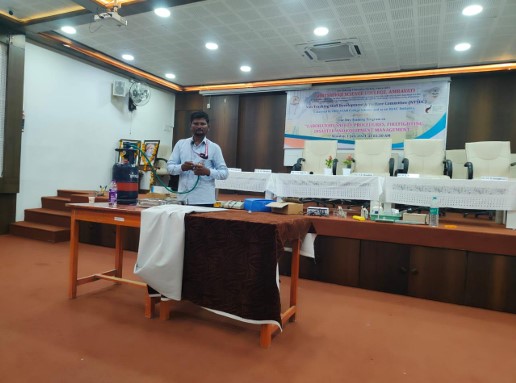 LPG Gas Cylinder Utilization demo |
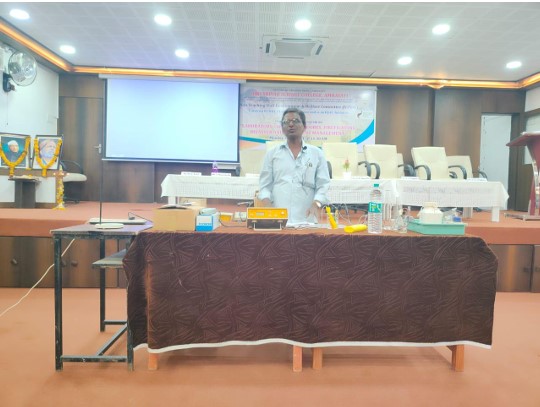 Shri Sudhakar Wankhade Conducting Session | 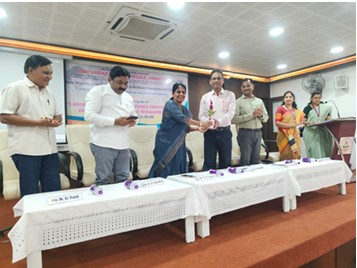 Inaugural Session of Workshop |
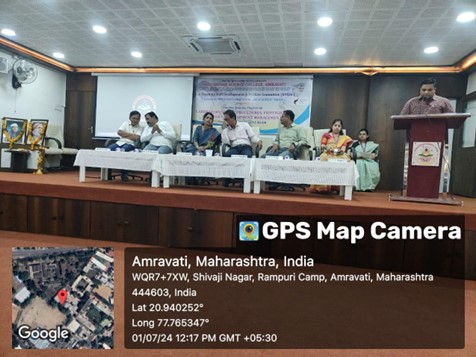 Inaugural Session of Workshop |
Attendance Sheet:
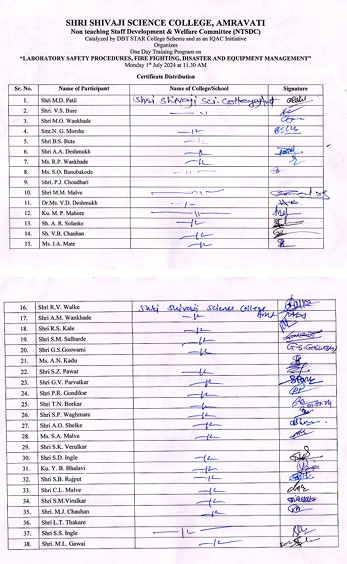 Sheet |
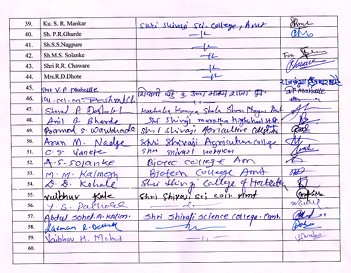 Sheet |
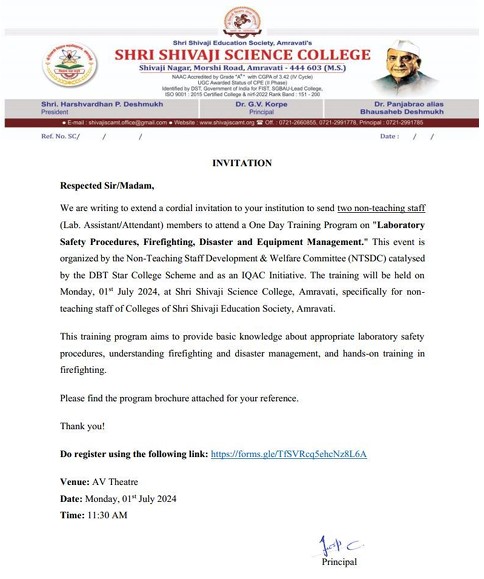 Sheet |
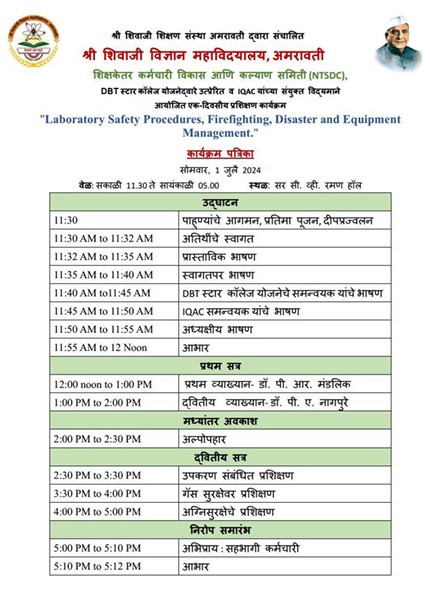 Sheet |